
Vrindavan · Uttar Pradesh
Radha Raman Temple, Vrindavan
Radha Raman is one of Vrindavan’s important historic Krishna shrines. Its connection with Gopala Bhatta Goswami and the sacred Shaligrama tradition gives it a distinctive Gaudiya Vaishnava identity.
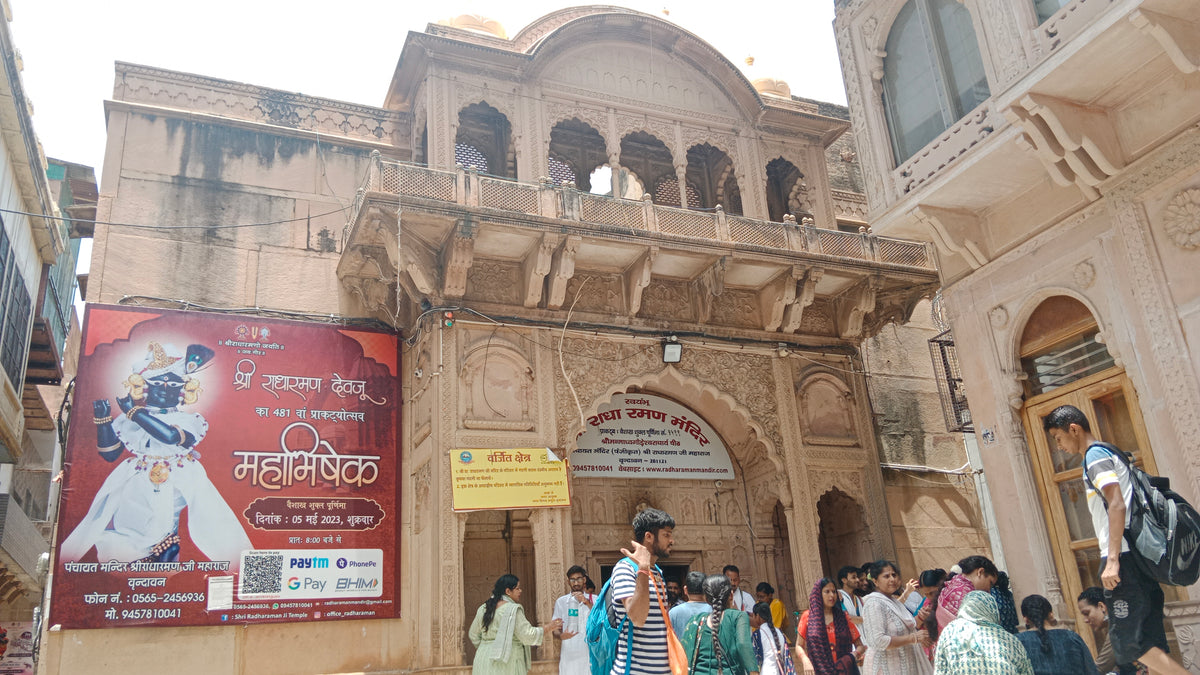
Radha Raman Temple, Vrindavan — exterior photograph Image source · Kridha20 · CC BY-SA 4.0. Resized for display.

Temple at a glance
- Location
- Vrindavan, Uttar Pradesh, India
- Main worship
- Krishna as Radha Raman
- Visit focus
- Radha Raman is one of Vrindavan’s important historic Krishna shrines.
Main deity and devotional image


Krishna as Radha Raman
History and setting
The temple’s foundation belongs to the sixteenth-century devotional flowering of Vrindavan. Gopala Bhatta Goswami is central to its history and worship lineage. The sacred account of the deity’s manifestation should be distinguished from the later architectural history of the surrounding temple.
Radha and Krishna in the Radharaman tradition
The Goswami-lineage account describes Radharaman as manifesting from a Shaligrama worshipped by Gopala Bhatta. Its explanation of the sanctuary is distinctive: there is no separate three-dimensional Radha image beside him, because the tradition understands Radha and Krishna to be present in this single form. Radha’s name is worshipped at his side. This is the community’s theological explanation, rather than a claim that a Radha image is missing.
Architecture and what to notice
The relatively intimate sanctuary demands a different pace from a large open temple campus. Observe from the permitted darshan area and leave room for regular devotees. A representative Krishna illustration elsewhere in this guide is not a photograph of the actual Radha Raman image.
Understanding Krishna seva
Krishna worship often describes service through a daily rhythm of awakening, dressing, food offerings, music and rest. Darshan can therefore pause even when the surrounding temple streets are active. The local image may show Krishna as a child, a royal lord, a charioteer or another devotional form. These identities should not be treated as interchangeable illustrations.
Tulsi has a special place in many Krishna traditions. Flowers and food offerings accompany devotion, but temple kitchens and sanctuary service follow their own procedures. Ask where a personal offering may be received and whether prasadam distribution is separate. At home, use the family’s customary preparation and a quantity that can be shared afterwards. A festival’s elaborate decoration is an expression of collective service, not a minimum shopping list for daily prayer.
Worship and offerings
The shrine is known for continuity of seva in its custodial tradition. Consult the temple for current darshan windows and offering rules. Tulsi, flowers and carefully prepared food have a place in Krishna devotion, but personal offerings should follow the local service arrangements.
Festivals and the devotional calendar
The deity’s appearance celebration and the wider Krishna festival calendar are important occasions to enquire about. Darshan may change with dressing, food offerings and seasonal services. Do not assume continuous access merely because the surrounding lanes remain busy.
Darshan, seva and the current calendar
The lineage’s FAQ explains Aulai darshan in relation to the early-evening Sandhya Aarti and the deity’s change of dress and preparation for a meal. This helps explain why darshan is organised around seva rather than continuous sightseeing. Use the current temple calendar and local guidance for the day’s access; a description of a devotional service does not by itself guarantee that the shrine will be open when you arrive.
Flowers and leaves for home puja
| Offering | Home-puja guidance |
|---|---|
| Flowers | Jasmine, rose and lotus |
| Leaves and other materials | Tulsi / tulasi leaves or a tulsi garland |
Tulsi has a special place in Krishna worship. Jasmine and rose are practical choices for a small home garland, while lotus can be reserved for a special occasion. Do not treat an elaborate festival flower display as a minimum requirement for everyday worship.
Use fresh, clean flowers and remove packaging before offering. These suggestions describe household practice; the temple may have its own rules for archana, garlands and ritual materials. Ask the authorised counter about a particular ceremony. Leaves and flowers should not be treated as medicines or promises of a particular outcome.
Home puja products
The cards below open actual products from Divine Flowers. Check the product page for options, availability and delivery details before ordering. A home flower selection is separate from a booking or offering service at the temple.
Flowers and deity-specific offerings
 Malli / Jasmine Loose (FF-MAL-008)$8.00View product →
 Red Rose Buttons (FF-BRR-002)$6.00View product →
 Pink Lotus (FF-LOP-011)From $2.00View product →
Home-puja essentials
 Brass Gulab Jyoti Deepam – 2 Inch Lotus Diya$5.40View product →
 Poo Thiri (Puja Lamp Wicks)$1.00View product →
 Pooja Deepam Oil (Diya / Vilakku Oil)$2.00View product →
For a simple household prayer, prepare a clean space, water and a modest food offering according to family custom. Place the lamp on a stable surface with space around the flame. Keep loose petals and cloth away from it. Choose the items you need rather than assuming every product is required for every prayer.
Nearby temples and regional pilgrimage stops
Use the locations below to distinguish a nearby city stop from a longer regional journey. Check each temple’s opening arrangements before setting out.
Krishna Balaram Mandir
Raman Reti, Vrindavan
A separate modern Gaudiya Vaishnava temple.
View map → · Read temple guide →Banke Bihari Temple
Vrindavan
Another distinct Krishna shrine with separate entry arrangements.
View map → · Read temple guide →Location and visitor planning
Use Radha Raman Temple, Vrindavan. Plan the final approach through the town’s lanes and check restrictions on vehicles. Krishna Balaram Mandir is a separate Raman Reti destination, not another entrance to this shrine.
Before leaving, confirm the opening window for that day, the final approach from your transport drop-off, and the arrangements for footwear and belongings. If anyone in the group needs assistance, ask about the actual route to the darshan area; the presence of a road to the entrance does not prove that the interior is step-free. Choose clothing suitable for worship and check any temple-specific requirement.
Leave room in the itinerary for the main sanctuary, associated shrines and a quiet look at the architecture. For each additional destination below, open its own map pin and check its own schedule. The suggestions distinguish local stops from longer regional journeys. No unverified driving time or queue duration is promised.
Find this temple on the map →Timings, festival programmes and access rules can change. Consult the official sources below or the temple directly for the day of your visit.
Frequently asked questions
Who is worshipped here?
Krishna as Radha Raman. Radha Raman is one of Vrindavan’s important historic Krishna shrines. Its connection with Gopala Bhatta Goswami and the sacred Shaligrama tradition gives it a distinctive Gaudiya Vaishnava identity.
What makes this temple distinctive?
The relatively intimate sanctuary demands a different pace from a large open temple campus. Observe from the permitted darshan area and leave room for regular devotees. A representative Krishna illustration elsewhere in this guide is not a photograph of the actual Radha Raman image.
Which festival should I check before travelling?
The deity’s appearance celebration and the wider Krishna festival calendar are important occasions to enquire about. Darshan may change with dressing, food offerings and seasonal services. Do not assume continuous access merely because the surrounding lanes remain busy.
Are the product suggestions required for temple entry?
No. The linked items are optional supplies for home worship. Temple admission, darshan, archana and prasadam have their own arrangements. Check the temple’s accepted materials before bringing an offering, and reuse the lamp and vessels already available at home.
Can I combine the visit with other temples?
Use Radha Raman Temple, Vrindavan. Plan the final approach through the town’s lanes and check restrictions on vehicles. Krishna Balaram Mandir is a separate Raman Reti destination, not another entrance to this shrine. Use the separate map links below for each destination; a regional connection does not mean that the temples are within walking distance.
Sources and image credits
- Goswami-lineage website — temple history and worship tradition
- Goswami-lineage website — Radha’s presence and Aulai darshan
- Goswami-lineage website — current calendar and temple information
- Radha Raman Temple — supplementary background
Temple history and devotional traditions are distinguished in this guide. Information reviewed on 20 October 2026. Current visitor arrangements should be confirmed with the temple.
Header image: Image source · Kridha20 · CC BY-SA 4.0. Resized for display.
Devotional image: Image source · Raja Ravi Varma · Public domain. Resized for display.