
Namakkal · Tamil Nadu
Namakkal Narasimhaswamy and Namagiri Thayar Temple
Namakkal’s Narasimhaswamy Temple combines a rock-cut sanctuary, powerful Vaishnava imagery and the deeply loved presence of Namagiri Thayar. The great rock behind the town is part of the temple’s identity, while the nearby open-air Anjaneyar shrine creates a closely connected pilgrimage. A visit is most rewarding when Narasimha, Namagiri and Hanuman are understood together.
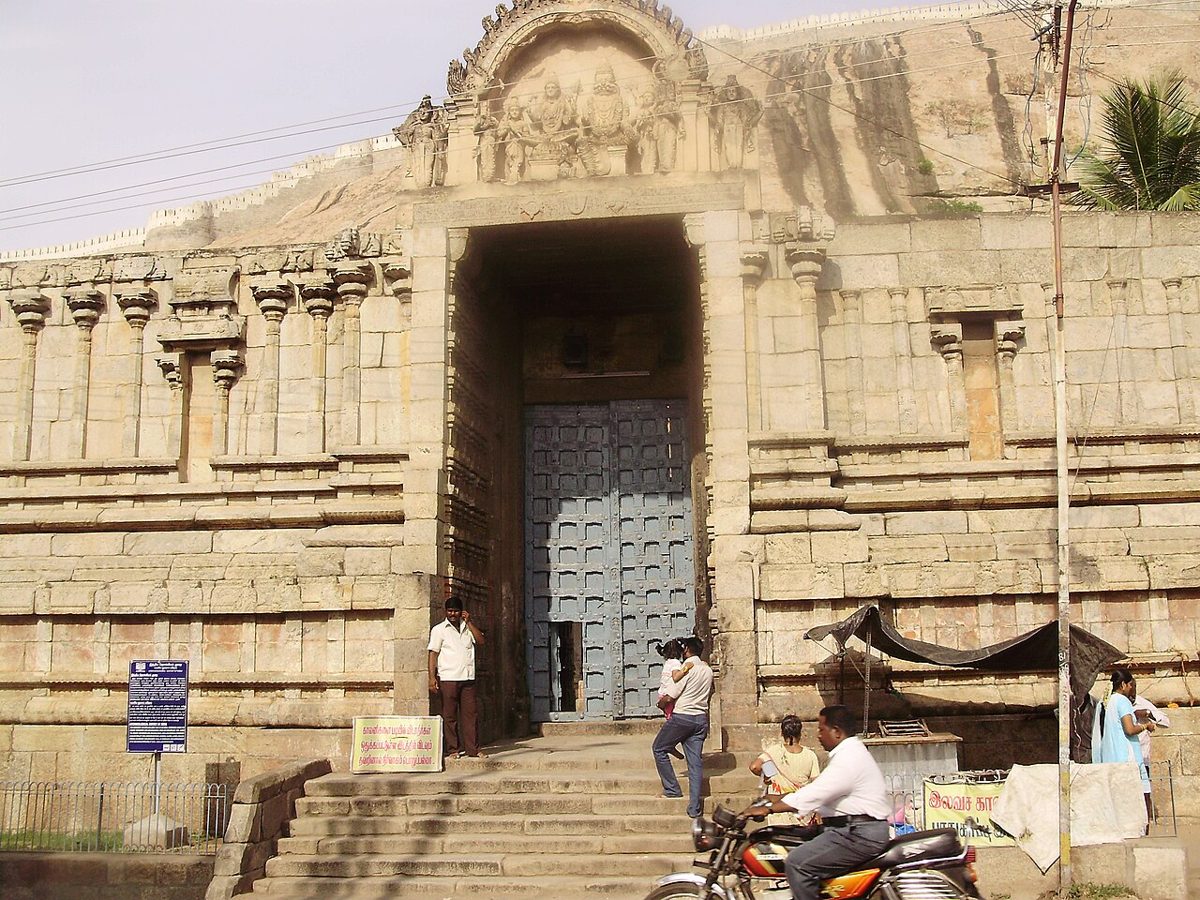
Narasimhaswamy Temple, Namakkal — exterior photograph Image source · Ilasun · CC BY-SA 3.0. Resized for display.

Temple at a glance
- Location
- Namakkal, Tamil Nadu, India
- Main worship
- Vishnu as Narasimha; Lakshmi as Namagiri Thayar
- Visit focus
- Namakkal’s Narasimhaswamy Temple combines a rock-cut sanctuary, powerful Vaishnava imagery and the deeply loved presence of Namagiri Thayar.
Main deity and devotional image


Vishnu as Narasimha; Lakshmi as Namagiri Thayar
History and the rock-cut setting
The sanctuary belongs to the early medieval rock-cut tradition of Tamil Nadu. Historians have proposed different dates and dynastic associations, so it is more accurate to describe its early medieval character than to present one disputed year as certain. The rock itself is much older than the temple; the geological age of a hill is not the construction date of its shrine.
Rock-cut architecture means that important sacred spaces and sculptures were excavated from living rock. This differs from assembling a building entirely from separate masonry blocks. The contrast is worth noticing here: the hill is both the physical setting and part of the material from which the worship space emerges. Later additions and ongoing ritual use form further layers of the temple’s history.
Narasimha, Namagiri and the sacred narrative
The local story connects Lakshmi’s penance with Hanuman carrying a sacred saligrama. When it is placed on the ground, the presence becomes established at Namakkal, and Narasimha appears. This is the temple’s devotional account of origin. It gives religious meaning to the landscape, rather than functioning as a dated historical chronicle.
Namagiri Thayar is not a minor stop added to a Narasimha visit. Devotees approach the goddess with a distinct relationship of prayer and trust, and the temple’s festival information notes the custom of visiting her shrine before Narasimha’s. Follow the order indicated locally. The large Anjaneyar image nearby forms another part of this sacred relationship, but it has its own worship space.
Architecture and sculpture to look for
Narasimha is seen in a seated form, surrounded by a sculptural setting that deserves attention beyond a quick glance at the main image. Reliefs associated with Vishnu’s forms and stories include Trivikrama and the reclining Vishnu. The work helps visitors understand how a cave sanctuary could communicate a broad religious world through a limited architectural space.
Look at the carved forms from the permitted viewing area, allowing your eyes to adjust to changes in light. Do not use a flash or approach a restricted surface to obtain a photograph. A useful question for a guide is how the central seated image relates to the narrative reliefs around it. That approach reveals more than trying to identify the whole complex with a single artistic label.
Namagiri and Srinivasa Ramanujan
The goddess Namagiri is closely associated with the personal faith of mathematician Srinivasa Ramanujan and his family. Accounts of his life describe the importance he attached to her inspiration. This connection is one reason people with an interest in intellectual history visit the shrine as well as those making a devotional journey.
It is important to describe the association accurately: it concerns Ramanujan’s faith and the way he understood inspiration. It is not a claim that a temple visit guarantees mathematical ability or that mathematical results need no proof. The combination of a remarkable human life and a continuing religious tradition gives Namakkal a distinctive place in the cultural imagination.
Festivals and the rhythm of worship
The Panguni festival and chariot celebrations bring the deities into the streets and make the surrounding town part of the pilgrimage. The temple’s annual programme should be checked for the exact dates and sequence. A chariot day is a different experience from an ordinary morning darshan, particularly for travel, parking and time spent in a queue.
For a quieter visit, plan around the temple’s current opening periods and allow time for both the goddess and Narasimha. Do not assume the adjacent Anjaneyar shrine follows exactly the same schedule. A practical itinerary includes the two locations without rushing either, and leaves the fort or other sightseeing as a separate decision.
Flowers and leaves for home puja
| Offering | Home-puja guidance |
|---|---|
| Flowers | Jasmine, lotus and rose |
| Leaves and other materials | Tulsi / tulasi leaves |
Tulsi is the distinctive leaf offering in many Vishnu traditions. Jasmine (malli / mogra), lotus (thamarai / kamal) and rose are familiar accompanying flowers. Maruvam / marukozhundhu and davanam are aromatic foliage used in some Vaishnava flower offerings; their documented use at Tirumala does not establish a compulsory rule for every Vishnu shrine.
Use fresh, clean flowers and remove packaging before offering. These suggestions describe household practice; the temple may have its own rules for archana, garlands and ritual materials. Ask the authorised counter about a particular ceremony. Leaves and flowers should not be treated as medicines or promises of a particular outcome.
Home puja products
The cards below open actual products from Divine Flowers. Check the product page for options, availability and delivery details before ordering. A home flower selection is separate from a booking or offering service at the temple.
Flowers and deity-specific offerings
 Malli / Jasmine Loose (FF-MAL-008)$8.00View product →
 Pink Lotus (FF-LOP-011)From $2.00View product →
 Red Rose Buttons (FF-BRR-002)$6.00View product →
Home-puja essentials
 Brass Gulab Jyoti Deepam – 2 Inch Lotus Diya$5.40View product →
 Poo Thiri (Puja Lamp Wicks)$1.00View product →
 Pooja Deepam Oil (Diya / Vilakku Oil)$2.00View product →
For a simple household prayer, prepare a clean space, water and a modest food offering according to family custom. Place the lamp on a stable surface with space around the flame. Keep loose petals and cloth away from it. Choose the items you need rather than assuming every product is required for every prayer.
Nearby temples and regional pilgrimage stops
Use the locations below to distinguish a nearby city stop from a longer regional journey. Check each temple’s opening arrangements before setting out.
Namakkal Anjaneyar Temple
Namakkal town, near the Narasimha temple
The prominent open-air Hanuman shrine is the closest complementary devotional visit.
View map → · Read temple guide →Ardhanareeswarar Temple
Tiruchengode, Namakkal district
A regional hill-temple extension devoted to Shiva and Parvati in a united form; it requires a separate road journey.
View map →Arappaleeswarar Temple
Kolli Hills, Namakkal district
A longer hill-country Shiva pilgrimage. Treat it as a separate excursion rather than a short walk from Namakkal.
View map →Location and visitor planning
The Narasimha complex is in Namakkal town by the western side of the rocky hill. Namakkal lies on the Salem–Karur travel corridor and has a railway station on that route. Use the Narasimhaswamy or Namagiri Thayar map destination, since a search for the fort alone can lead to a different approach.
If including Tiruchengode or Kolli Hills, account for road conditions and the extra time needed at hill temples. Within Namakkal, keep the temple visit and the fort climb separate in your planning. Ask about access arrangements for anyone with limited mobility before attempting steps or uneven surfaces.
Find this temple on the map →Timings, festival programmes and access rules can change. Consult the official sources below or the temple directly for the day of your visit.
Frequently asked questions
Is this temple a Divya Desam?
Namakkal Narasimhaswamy is an important Vishnu temple, but it is not one of the canonical 108 Divya Desams.
Should I visit Namagiri Thayar too?
Yes. Her shrine is an important part of the temple’s devotional identity. Follow the worship order indicated by the temple.
Is the Anjaneyar temple the same sanctuary?
No. It is a nearby and closely connected Hanuman shrine, usually included as a separate stop.
Sources and image credits
- namakkal.nic.in —
- www.utsav.gov.in — car festival arulmigu narasimha swamy temple namakkal
- namakkalanjaneyar.hrce.tn.gov.in — temple more info.php?tid=4887
- en.wikipedia.org — Narasimhaswamy Temple, Namakkal
Temple history and devotional traditions are distinguished in this guide. Information reviewed on 20 October 2026. Current visitor arrangements should be confirmed with the temple.
Temple photograph: Image source · Ilasun · CC BY-SA 3.0. Resized for display.
Devotional image: Image source · Unknown nineteenth-century artist; Wellcome Collection · Public domain. Resized for display.