
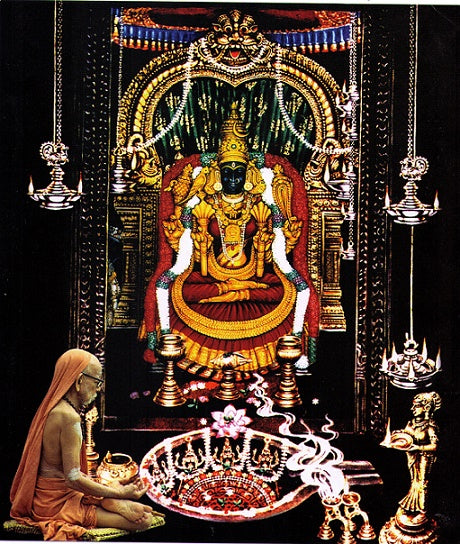
Kanchipuram, Tamil Nadu
Sri Kamakshi Amman Temple
Sri Vidya worship, the Goddess's sacred seat and the festival life of Kanchi.
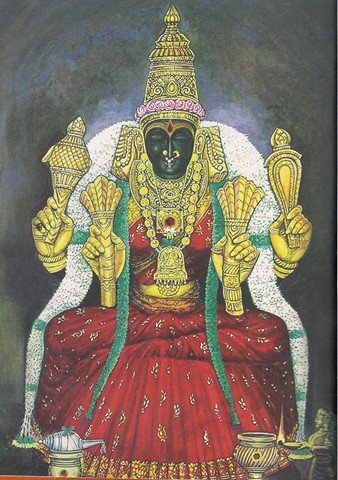
Devotional artwork of Kamakshi Amman · Wikimedia Commons, public domain

Official temple website: Sri Kamakshi Ambal Devasthanam
Overview
Kanchi Kamakshi is the presiding Goddess of this Shakta shrine in Kanchipuram, Tamil Nadu. The Tamil name is காஞ்சி காமாட்சி அம்மன். A devotional explanation of her name understands Saraswati and Lakshmi as her two eyes, connecting knowledge and abundance with the Goddess's compassionate gaze. This is a religious interpretation, not a historical derivation.
The Devasthanam describes Kamakshi seated in Padmasana in the Gayatri Mandapam, with a sugarcane bow and attributes associated with Sri Vidya. The shrine's Sri Chakra worship is central to its identity. Its own tradition identifies Kanchi among the Shakti Peethas; lists and counts differ between traditions.
Architecture and shrines to notice


The temple is more than its entrance towers. The Gayatri Mandapam forms the heart of worship; the tank provides the setting for float observances, while halls and courtyards accommodate the festival cycle. The official shrine list includes Varahi, Arupa Lakshmi, Ganapati and Kalvar Perumal near the central sacred area; Saraswati, Annapoorani, Sastha and Adi Shankaracharya in the prakaram; and Bhairava, Mahishasura Mardhini and Kashi Viswanathar in the outer circuit. Ask temple staff about access rather than assuming every shrine is open throughout the day.
History and devotional tradition
The shrine belongs to Kanchipuram's long and layered religious history. Its traditional association with Adi Shankaracharya and the Sri Chakra must be distinguished from a securely dated building chronology. The available official pages do not establish a complete inscription-based sequence of builders and renovations, so a single definitive founding date is not asserted here.
Daily pujas, weekly sevas and monthly observances
The Devasthanam's published schedule lists morning Go Puja and Viswarupa Darshan, three daily abhishekam periods, evening Arthajama worship and Palliarai Puja. These mark the opening, daytime worship and ceremonial close of the deity's day.
- Wednesday and Saturday: Sandana Kappu for the main deity.
- Friday: golden-chariot procession within the prakaram.
- Full moon: Navavarna Pooja at night; the official page says devotees are not admitted to the Gayatri Mandapam during this ritual.
- Other monthly days: the first Tamil-calendar day and new moon are also listed for chariot worship.
- Archana: the official page describes Sahasranama Archana after midday worship and Kumkuma Archana at the Sri Chakra.
These are the temple's published patterns, checked on 19 October 2026. Festival exceptions and booking availability require confirmation with the Devasthanam. Old online fee tables are not quoted as current prices.
Major annual festivals: what happens and why it matters
Masi Brahmotsavam: the temple's festival account describes flag hoisting, successive vehicle processions, the wooden and silver chariots, sacred-water observance and lowering of the flag. Public processions allow devotees to worship the utsava form beyond the sanctum. The subsequent Vidaiyatri period changes the atmosphere to swing darshan and quieter observances, ending with a flower palanquin.
Sharada and Vasantha Navaratri: the official puja page describes nine-day celebrations with a special yagasala and Chandi Homam. Shankara Jayanti: the older festival guide records recitation of Soundarya Lahari and a procession associating the Acharya with Kamakshi. Vasanthotsavam: the same guide describes a spring observance coordinated with the Varadaraja Garuda Sevai season. These descriptions explain the recurring tradition; use a newly issued temple calendar for exact dates and sequence.
Prasadam, flowers and offerings
For sponsored-seva prasadam, the Devasthanam specifically directs devotees to the temple Maniyakar. Ask when and where to collect it; a booking does not establish a particular food menu. The festival guide describes green-gram and jaggery preparations during Payatankanchi Vidaiyatri, a particular seasonal offering rather than an everyday distribution promise. Kumkum is integral to Sri Chakra archana. Ask staff before bringing flowers, garlands or other offerings; the official guidance requires approval for contributions in kind.
Planning a visit
Allow time for worship and the surrounding shrines. Kamakshi and Kumarakottam form a useful central-city pair; Ekambareswarar adds the earth-element Shiva tradition, Kailasanathar the Pallava architectural story, and Varadaraja the Vishnu Kanchi pilgrimage. A two-day visit allows these distinct experiences without rushing. Opening-hour exceptions, entry arrangements, photography rules and route times must be checked for the travel day.
Frequently asked questions
Which weekly sevas are documented?
The official schedule lists Wednesday/Saturday Sandana Kappu and Friday golden-chariot worship. Confirm festival exceptions directly.
Is there a daily food-prasadam menu?
A current daily distribution menu was not established by the official sources checked. Sponsored-seva devotees are directed to the Maniyakar.
What makes the full-moon worship different?
Navavarna Pooja is connected with the temple's Sri Vidya worship, and access to the Gayatri Mandapam is restricted during it according to the official page.
Sources and verification
Divine Flowers · Home Pooja
Bring devotion home
For Amman Pooja at home, explore jasmine and Mullai strings with kumkum from Divine Flowers.

Malli / Jasmine String (FF-MAS-018)
$14.00
View product
Mullai String (FF-MUS-017)
$14.00
View product
Pooja Kumkum (Kungumam / Kumkuma) — 100 g
$3.00
View productExplore Pooja garlands · Browse Pooja supplies
These are optional supplies for home worship. Choose according to your family tradition and product instructions. Divine Flowers is an independent retailer; these selections are not temple-endorsed offerings.
Related temples
Continue exploring the history, beauty and devotional traditions of these temples.

Ekambareswarar Temple
The earth-element Shiva shrine, sacred mango tree and divine-wedding festival.
Read the guide →
Varadaraja Perumal Temple
Vishnu Kanchi, Garuda Sevai and the distinctive Kovil idli tradition.
Read the guide →
Kailasanathar Temple
Pallava sandstone architecture, sculpted Shiva forms and a living sacred monument.
Read the guide →
Kumarakottam Murugan Temple
Murugan as Brahmasasta and the Tamil literary legacy of the Kanda Puranam.
Read the guide →Research preview · Read the verification notes before making travel plans. Current schedules, route distances and travel times have not all been confirmed.