
Dwarka · Gujarat
Dwarka Dwarkadhish Temple
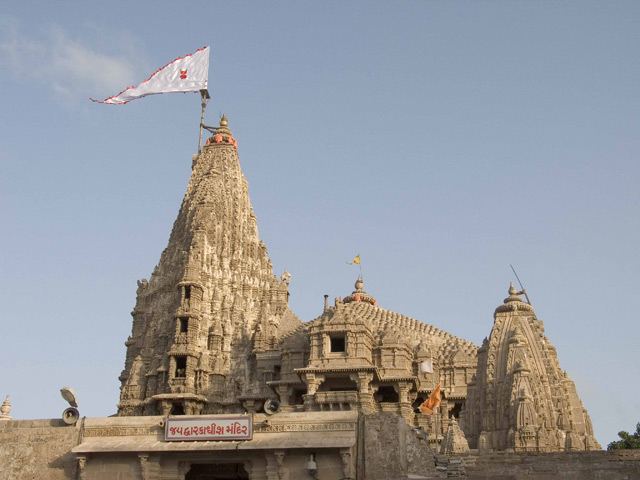
Dwarka Dwarkadhish Temple — temple exterior. Sources & photo credit ↓
Government of Gujarat — Dwarkadhish Temple ↗
Overview
Dwarkadhish, the Lord of Dwarka, is Krishna’s form worshipped at the Jagat Mandir in Gujarat. The shrine belongs to both the Divya Desam and Char Dham traditions.
History & origins
The site has ancient antecedents, while the surviving major structure reflects rebuilding and enlargement during the fifteenth and sixteenth centuries.
Architecture & beauty
The multi-storeyed sanctuary, carved pillars and soaring temple profile give Dwarka a distinctive western Indian architectural character.
Worship & traditions
The sacred identity recalls Krishna’s kingdom. The historic site and the surviving building have different chronologies, so legendary antiquity should not be presented as the construction date of the current temple.
Krishna as Lord of Dwarka
Dwarkadhish means the Lord of Dwarka, placing Krishna’s royal identity at the centre of the temple’s worship. This gives the destination a different mood from Gokul’s childhood traditions. The same deity is encountered through a city, a courtly identity and the memory of a kingdom.
The main temple is also known as Jagat Mandir. Retain both names when comparing sources, since a visitor may hear either used for the principal sanctuary.
The main temple and the wider pilgrimage
The district’s heritage account identifies Rukmini’s temple, Gomti Ghat and Bet Dwarka among the wider destination’s sacred places. These are related stops, not alternative names for the same building. A clear itinerary distinguishes the main temple from the wider circuit.
Rukmini’s presence is important to understanding the divine household, while the riverfront and coastal setting give the pilgrimage its geography. Allow each part its own meaning rather than treating every stop as a quick extension of one darshan.
Sacred tradition and archaeology
Dwarka carries a powerful tradition of Krishna’s city, and the district notes archaeological investigations both onshore and offshore. Archaeological evidence and sacred narrative should be described distinctly; the existence of research does not by itself prove every detail of a puranic account.
This careful distinction makes the destination more interesting, not less. Visitors can appreciate living worship, the city’s legendary significance and material investigations without forcing them into one oversimplified historical claim.
Sources for the expanded guide
Related pilgrimage guides
These guides share a wider pilgrimage tradition; they are not necessarily close enough to visit on the same day.


Divine Flowers · Home Pooja
Bring devotion home
For Perumal or Venkateswara Pooja at home, explore fragrant Mullai strings, Maruvam and Dhavanam from Divine Flowers.

Mullai String (FF-MUS-017)
$14.00
View product
Maruvam (FL-MAR-001)
$7.00
View product
MariKolunthu / Dhavanam (VE-DHA-001) Vaikunta Ekadesi
$7.00
View productExplore Pooja garlands · Browse Pooja supplies
These are optional supplies for home worship. Choose according to your family tradition and product instructions. Divine Flowers is an independent retailer; these selections are not temple-endorsed offerings.
Sources & photo credit
- Wikipedia: Dwarka Dwarkadhish Temple — background and bibliography
- Government of Gujarat — Dwarkadhish Temple
- Photograph: Scalebelow · Wikimedia Commons — CC BY-SA 3.0. Photograph resized for display; no subject alteration.
